Logica fuzzy
 |
Questa è una pagina di introduzione al corso: contiene i turni, le modalità d'insegnamento, alcune informazioni generali ed eventuali giudizi sul corso in questione. Se sei giunto qui passando da un link, puoi tornare indietro e correggerlo in modo che punti direttamente alla voce appropriata. |
Indice
A.A. passati
Information
Course's website
Times and classrooms:
Monday 15:30 - 17:30 - Room 5 (Ground floor - via comelico 39)
Friday 10:30 - 12:30 - Room 5
Lessons' notes
This notes are written in english to help foreign students to follow this course.
Classical Propositional Logic
We are going to describe the classical propositional logic (L.P.C) language.
Syntax
The syntax of a language is the set of rules that specify how the elements of the language are formed regardless their meaning.
Let  be the set of the natural numbers and
  an alphabet of symbols.
 is the set of strings on this alphabet. For example
  .
.
We have now to define the set of the "well formed formula"  , that is the set of the elements of the L.P.C.
Definition (well formed formulas).  is defined with some conditions:


 , where | is taken n times. For example:
- if
 , then
  .
. - if , then
 .
. - if , then
 .
. - if , then
 .
.
Well formed formulas is often abbreviated with f.b.f.
The strings in condition (2) are called "propositional variables" or "atomic formulas" or "propositional letters" or simply "variables". They are abbreviated with this notation:
 (In other books p, q, r, .., are used to refer to variables).
The set of variables is  .
.

Example of well formed formulas:

Instead

In this notes we omit (, ) where it is clear the precedence of the connectives. (Connectives are  )
)
Why don't we use directly  or
or  ?
?
Because it is important that the alphabet is a finited set. Although, in this notes, we use  notation.
It is essential, even, that the L.P.C. language is decidable, that is it must exist an algorithm that tell us if a string is
notation.
It is essential, even, that the L.P.C. language is decidable, that is it must exist an algorithm that tell us if a string is  or not.
For this reason it is crucial the
or not.
For this reason it is crucial the
Unique readability of well formed formulas. For all  one (and only one) of the following sentences must be true:
 or
or  but not both.
- Exists an unique
 such that
  .
. - Exists an unique
 such that
  .
. - Exist unique
 such that
  .
. - Exist unique such that
 .
. - Exist unique such that
 .
.
Let's, infact, consider the parser of the algorithm we talked above:
When it find, for example,  , to decide if the string belongs to FORM, it have to decide (for the unique readability of well formed formulas) if
  . But how can it do this? Deciding if and .
This is what the above theorem tell us. Try to draw the parser tree. It is unique thanks to, again, that theorem.
. But how can it do this? Deciding if and .
This is what the above theorem tell us. Try to draw the parser tree. It is unique thanks to, again, that theorem.
Formally, a string  is a finite sequence of elements:

A substring of is a string in the form  , where
  and
and  .
.
A subformula is a substring .
For example:


 are both substring of but only
  is a subformula.
With
is a subformula.
With  we indicate the set of variables that are subformulas of .
With
we indicate the set of variables that are subformulas of .
With  we denote a formula whose variables are a subset of
  .
.
Semantic
The semantic of a language is the relation between the elements of that language and their meaning.
The set {0,1} is called truth values set. 0 means false and 1 means true.
Definition(Assignment). An atomic assignment is any function
 .
.
An assignment (or interpretation) is a function

that extends  and respects the following rules for every
  .
.
 and
and 
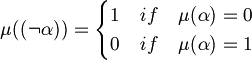



Informally we can say that the variables represent propositions with one verb and one or more complement. For example:
 "It rains";
 "I go to school".
 "I don't go to school"
 "It rains and I go to school"
 "it rains or I go to school"
 "If it rains I will go to school"
I can choose such as 


